
If you’ve ever skied before, you know the feeling.
You study the trail map. The numbers make sense. The route is clear. Then halfway down the mountain, the terrain changes. Fresh snow hides patches of ice. Suddenly, the route you expected is no longer the one in front of you.
The mountain has simply introduced new information. Maybe, it revealed something you couldn’t see from the top.
Business ownership has a way of doing just the same.
Someone resigns unexpectedly. A customer changes direction. A marketing campaign underperforms.
Every business eventually presents situations that weren’t included in the brochure or FDD. And the leaders who navigate those moments well will dwell on what disrupted the plan, and they become curious about what the disruption is revealing.
That begins with mental clarity, the first pillar of entrepreneurial success.
Events alone don’t determine our emotional response. Our interpretation of those events shapes how we think, decide, and act. Past experiences, learned reactions, and old survival patterns can quietly influence how we respond when the terrain changes.
Two executives can face the same obstacle. One experiences it as evidence that something is falling apart. Another sees information that helps refine a decision. Even though the circumstances are identical, the interpretation creates two very different outcomes.
Mental clarity in this scenario means creating enough space to recognize what’s happening before reacting to it.
Even a five-minute morning ritual can help: slow your breathing, visualize the day ahead, and identify the one goal that deserves your attention. The practice is simple. The discipline is learning to lead your thinking before the day’s problems begin leading it for you.
Understanding uncertainty and setting expectations begin with knowing where the business sits on your owner involvement spectrum.
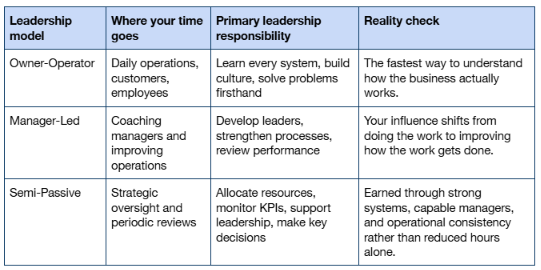
Semi-passive ownership isn’t created by spending fewer hours at the business. It develops as leadership, systems, and trust mature together. The fewer decisions that depend on your immediate presence, the more your role shifts toward guiding the business instead of carrying it.
A hard hat is worn because uncertainty is respected.
Business ownership deserves the same mindset.
The executives who transition successfully into ownership build processes before they’re urgently needed. They strengthen leaders before stepping back.
Every trail eventually changes. The leaders who navigate it well keep learning long after one journey ends.
If you want to gain an advantage, let’s connect, and we will study how to read the terrain while everyone else is still looking at the map.