

Business ownership has a way of rewarding initiative.
Many executives build remarkable careers because they’re the person others count on during difficult moments.
They solve problems quickly, make thoughtful decisions, and shoulder responsibilities that others avoid.
Those qualities build exceptional leaders.
However, the most dangerous player on a championship team acts like a strong, infallible leader.
Every possession runs through them. Every decision waits for them. Every teammate looks in their direction before making the next move.
It feels like leadership, but over time, it becomes a recipe for overdependence. In ownership, it quietly builds businesses that cannot operate without them.
One lesson Erica and I have learned while helping executives explore franchise ownership is that the businesses creating the most freedom depend on systems and capable teams that know how to perform even when the owner isn’t in the room.
Instead of concentrating every important decision in one person, responsibility is intentionally shared across capable people with clear accountability. Decision-making improves because ownership is shared without sacrificing standards.
That’s one reason semi-passive ownership should never begin with the question,
How quickly can I step away?
A better question is,
Who needs to grow before I can?
Instead of assuming the business would eventually run itself, earn the flexibility you want one decision at a time.
And delegation isn’t a single decision. It’s a progression.
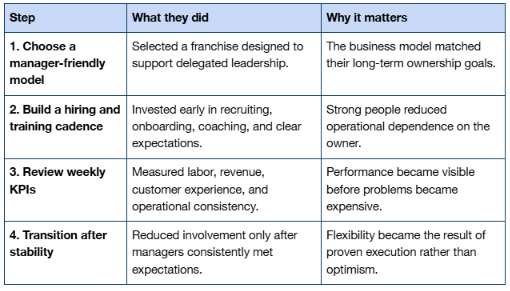
An owner doesn’t simply wake up one morning and decide to become semi-passive.
The business earns that transition because the leadership team earns the owner’s trust.
But there is a deeper question underneath delegation:
What are you actually trying to create?
That’s a significant pillar of entrepreneurial success: spiritual alignment and purpose.
You don’t need to figure out everything immediately. A business can gradually become a powerful vehicle for serving customers, creating opportunities for employees, supporting your family, or contributing to something larger than yourself.
For some leaders, that purpose is rooted in faith. For others, it is service, family, community, or a personal mission.
Whatever form it takes, knowing what your work is for, ultimately changes how you lead it.
Take time to write down the specific impact you want your business and your life to make.
Not just the revenue target. Not just the number of locations.
Ask who benefits from what you’re building and what you want your leadership to make possible.
That clarity can make delegation easier, because the business stops being an extension of your identity and becomes a vehicle for your purpose.
Championship teams don’t win because one player carries everyone else.
They win because everyone understands their role, trusts one another, and executes the game plan together.
That’s exactly the kind of ownership question worth talking through together. I can help you look at your leadership readiness, the ownership path that fits your goals, and the milestones that could support your intentional transition.
If you’re serious about creating a business that gives you greater freedom and purpose, I’d love to continue the conversation here.
Great ownership is no longer about being the player who takes every shot.
It’s about building a team you trust to carry the ball.