

Every good book has a chapter the reader can’t skip.
It’s usually the one where the main character gets lost.
The plan stops working. Confidence gives way to uncertainty. The person who began the journey isn’t quite capable of finishing it, so the story asks them to evolve into someone else.
Business ownership has a chapter like that, too.
Many executives spend years solving complex problems, leading people, and making decisions with significant consequences.
Even so, the first months of ownership ask you to learn a new language. You stop leading a department and begin understanding every moving part of a business.
The temptation is understandable.
If the long-term goal is semi-passive ownership, why not start there?
Because leadership grows through exposure before it grows through delegation.
Learning happens when we move beyond familiar routines into manageable levels of challenge.
Too little challenge leads to stagnation.
Too much creates overwhelm.
The goal is steady expansion, where each experience builds capability for the next.
I’ve seen that pattern repeatedly in franchise ownership. The executives who become effective semi-passive owners are the ones who move through stages with intention.
But do not fear challenges.
A hiring mistake teaches you what to look for in the next candidate. A difficult customer conversation sharpens your service standards. An underperforming marketing campaign forces you to understand your local market more deeply.
Those experiences aren’t interruptions to becoming a business owner.
They’re the process of becoming one.
This reminds me of the Japanese art of Kintsugi. When a piece of pottery breaks, the cracks are repaired with lacquer mixed with gold. The repair doesn’t erase the damage. It becomes part of the object’s history and, in many ways, part of its beauty.
Business ownership often leaves similar marks.
But there is another part of the climb executives sometimes overlook: the condition of the person doing the climbing.
Physical vitality is one of the pillars of entrepreneurial success.
Physical health transfers well to leadership performance. It is also part of the foundation beneath it. Long hours and sustained pressure become harder to manage when recovery, nutrition, hydration, and sleep are consistently neglected.
Burnout, sometimes, is the accumulated result of never giving the body enough resources to recover from the work.
That makes self-care a leadership practice.
Start by understanding your baseline. Look honestly at your sleep patterns, nutrition, hydration, energy, and other health markers. Where appropriate, discuss bloodwork and other relevant testing with a qualified healthcare professional.
The objective is to make sure the person building the business has the capacity to sustain the journey. Again, each day builds capability for the next.
That’s why I often encourage executives to think about their transition in three phases rather than one.
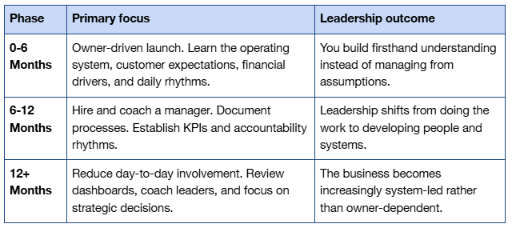
The owner’s value evolves.
Early on, your presence creates consistency. Later, your systems and judgement will retain that consistency.
Skipping the first phase often creates problems that surface much later.
Managers inherit processes that were never clearly defined. Performance suffers because expectations were never documented. Owners find themselves pulled back into daily operations because the foundation was never fully built.
Hiking offers a similar lesson. No one reaches the summit by helicopter and calls it experience.
The climb develops the judgment to navigate the next trail. Each switchback teaches you something the map never could.
And every climb requires the strength to keep going.
Every business owner has a chapter they wish they could skip.
More often than not, it’s the chapter that prepares them to lead the rest of the story.
And you need the clarity, resilience, and physical capacity to finish it.
If this resonates with you, have a seat and let’s talk about what your next chapter could look like.