
The voice that keeps you awake at 2 a.m. is not always your enemy.
Sometimes it is the part of you trying to prevent an expensive mistake.
One voice pushes for action.
Another wants more information.
A third quietly reminds you everything that could go wrong.
You have probably hosted this meeting more times than you can count. It happens before a major acquisition, during a restructuring, or the night before announcing a decision that will affect the people you love.
Business ownership has a way of inviting these conversations again.
Leaving a successful corporate career stirs emotions that spreadsheets can’t explain. You’re stepping away from a familiar operating system. The title you’ve earned, the team you’ve built, and the rhythm you’ve mastered have shaped your identity for years.
Even when the opportunity is exciting, uncertainty naturally follows.
One framework I’ve found surprisingly useful is Internal Family Systems, or IFS.
Rather than treating anxiety or self-doubt as weaknesses to overcome, IFS suggests they are different “parts” trying to protect us. Beneath those parts sits something steadier: the core self. It’s the part of us capable of curiosity, compassion, and thoughtful leadership.
Instead of asking, Why am I feeling anxious?
Ask, What is this part trying to protect me from?
Sometimes it’s protecting your family from unnecessary financial risk.
Sometimes it’s protecting the career you’ve spent decades building.
Sometimes it’s reminding you that the next chapter deserves the same diligence that helped you succeed in the last one.
Fear often carries information.
That is where emotional resilience, a pillar of entrepreneurial success, becomes essential.
Entrepreneurship will eventually test your ability to absorb pressure without letting pressure make every decision for you. Resilience is when hardship affects you but you still give yourself enough space to process what happened, recover, and continue showing up with clarity.
A simple emotional reset can help. Track the moments that trigger a strong reaction, then take two minutes to journal, breathe deeply, or step outside for a short walk.
I’ve seen this same psychology surface in conversations about semi-passive franchise ownership.
The phrase itself creates a powerful mental shortcut. Most people hear semi-passive and immediately picture fewer working hours.
Every business depends on someone to solve problems, coach people, make decisions, and protect the customer experience.
Semi-passive ownership becomes possible when those responsibilities gradually shift from the owner to capable managers supported by repeatable systems and measurable performance.
Before assuming a franchise supports a semi-passive lifestyle, I encourage executives to ask three questions:
- Who can solve today’s problems?
- Reveals how dependent the business is on the owner’s daily decisions.
- Who will develop tomorrow’s leaders?
- Strong managers create operational stability and long-term flexibility.
- What will happen if I disappear for two weeks?
- Exposes whether the systems are truly self-sustaining or still owner-dependent.
People naturally underestimate the time, effort, and complexity required to accomplish unfamiliar work.
Many first-time owners imagine stepping back within months. The businesses that successfully support semi-passive ownership usually earn that flexibility through repetition, documentation, coaching, accountability, and trust.
Different business models require different levels of owner involvement.
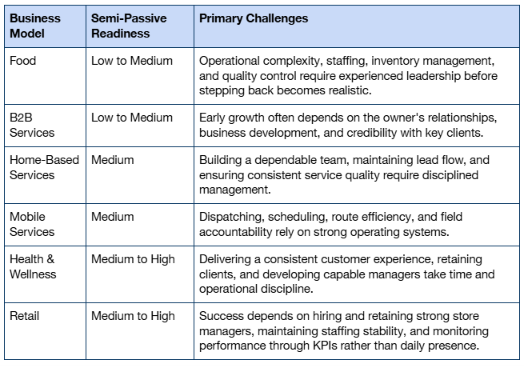
The goal is to become the kind of leader who makes semi-passive ownership possible. It requires the emotional capacity to remain steady when the plan changes, the numbers disappoint, or the people you trusted make mistakes.
Experienced surfers don’t wait for perfect waves.
They develop the judgment to navigate changing conditions.
Ultimately, every executive will eventually host an internal board meeting.
The quality of that conversation will determine the quality of every decision that follows.
If you’re looking for an experienced sounding board to help turn those conversations into a practical transition plan, let’s have a talk.